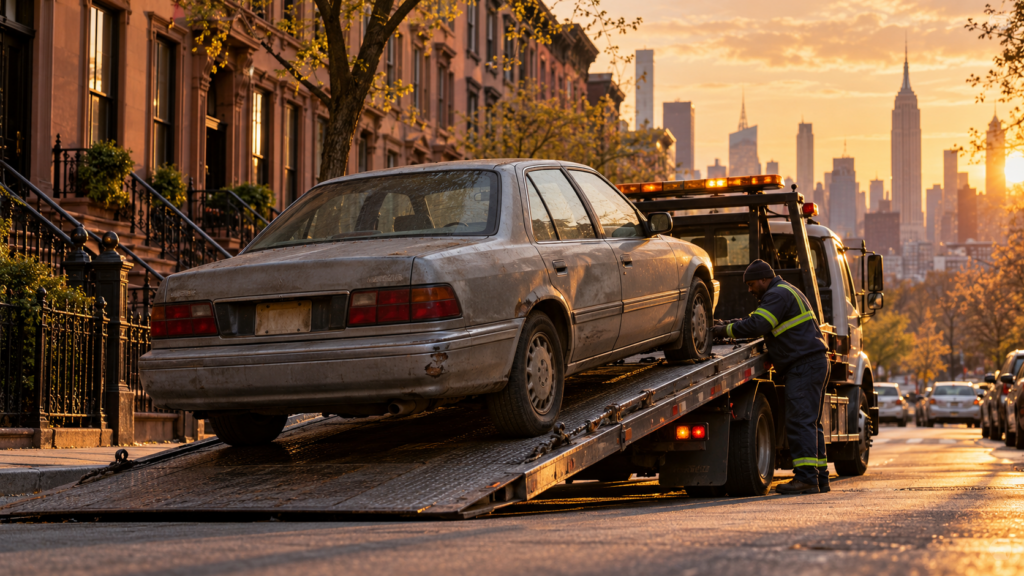
In New York City, an older car can become a losing proposition before it becomes a worthless one. Full-coverage insurance can cost roughly $4,500 a year, garage parking can add hundreds of dollars a month, and a major repair can approach the market value of an aging vehicle. Those costs can make ownership difficult to justify even when the car itself still has value.
The remaining value feeds a large secondary market. Some cars are resold or auctioned, while others are dismantled, recycled, or donated. Kars4Kids is among the organizations that accept vehicles in a wide range of conditions and move them into those same resale and recycling markets.
For cars that still have useful life, the path is often straightforward. A private sale, trade-in, or wholesale auction can put the vehicle back on the road with another owner. Mileage, condition, repair costs, and demand for a particular model all influence what a buyer is willing to pay.
Vehicles with serious mechanical problems or body damage move into a different market. Engines, transmissions, electronics, wheels, glass, and body panels can retain value even when the complete car does not. Once reusable components are removed, steel, aluminum, and other materials can return to the manufacturing supply chain. The Automotive Recyclers Association estimates that about 86 percent of a vehicle’s material content is recycled, reused, or recovered for energy.
New York’s salvage system governs another part of that market. Heavily damaged vehicles that meet state criteria must go through the required title and inspection process before they can return to the road. Others may be purchased for repair, dismantled for parts, or sent for recycling.
The same markets play a role when a car is donated. Kars4Kids assesses each vehicle after donation, taking into account factors including its age, mileage, condition, location, and the local market. The purpose is to determine which available sales channel is likely to produce the highest return for that particular car.
A working vehicle may go to an auto auction and eventually return to the used-car market. A car with limited resale potential may be worth more to a dismantler or scrapyard. Kars4Kids uses both routes, so the physical journey of a donated vehicle can look much like that of a car sold by an individual, dealer, or insurer.
For donors, the sale price has a direct tax consequence. Under federal tax rules, when a charity sells a donated vehicle for more than $500, the donor’s deduction is generally limited to the lower of the vehicle’s fair market value or the gross proceeds received by the charity. The charity then provides documentation of the sale. Separate rules apply in certain cases when a nonprofit keeps or materially improves the vehicle.
The same sedan can become auction inventory for a dealer, a replacement transmission in a Bronx repair shop, recyclable metal, or a source of program funding for Kars4Kids. A vehicle an owner is ready to give up can still provide value to several different parts of the secondary market. For Kars4Kids, the proceeds from those sales help fund youth and educational programs, converting an unwanted physical asset into charitable revenue.
For New Yorkers, the calculation often starts with insurance, parking, maintenance, and repair costs that no longer make sense relative to the car’s usefulness. Once the decision is made to sell, trade, scrap, or donate it, the vehicle enters a market built to recover whatever value remains. The end of ownership is often only the beginning of the car’s next life.

87 thoughts on “The Afterlife of New York’s Unwanted Cars”
Comments are closed.