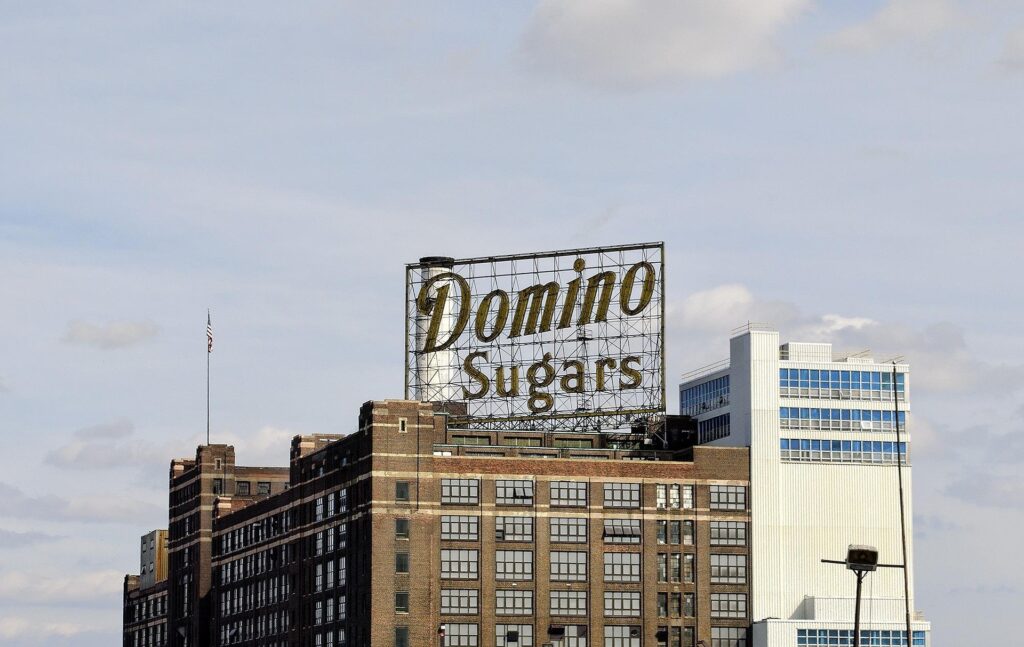
The Domino Sugar sign on the Williamsburg waterfront is one of Brooklyn’s reminders of an industry that was once central to New York’s economy. The refinery’s closing in 2004 marked the end of generations who witnessed sugar arriving in New York and passing through refinery buildings on its way to city bakeries, confectioners, restaurants, and households.
New York’s first sugar refinery opened in 1730, and by the middle of the 19th century more than 20 were working across New York and New Jersey. Sugar’s importance to New York extended to labor, with refining among the city’s most important manufacturing industries between the 1870s and World War I. Brooklyn eventually emerged as the country’s leading refining center, processing around 70 percent of the nation’s sugar by 1887.
Much of the raw sugar processed arrived on ships from Caribbean places including Cuba, Puerto Rico, and the British, French, and Dutch West Indies. That Caribbean sugar economy continued to develop in the early 20th century, including in the Dominican Republic, where Central Romana began growing sugarcane in 1912 and completed its first harvest five years later. After being unloaded at the East River docks, it was filtered, crystallized, dried, and packed. The trade supported a substantial labor force in New York’s refineries, as well as other businesses across the city. At its peak in 1919, the Williamsburg refinery alone employed approximately 4,500 people.
Although the refineries are largely gone, the Caribbean sugar industry that helped supply them is not. Nor is the zafra, the sugarcane harvest season that remains an important part of the agricultural calendar in sugar-producing areas of the Caribbean.
The zafra is a continuous agricultural and logistical process spanning from December into June or July. Once harvested, the cane needs to move to the mill quickly, where the industrial process of crushing, extraction, and sugar production can begin.
Central Romana provides a useful example of how much that process has changed in more than a century of running zafras. Its first took place in 1917, when its mill could process about 2,000 tons of cane per day. Today, more than 166,000 acres of its fields are planted with sugarcane, and its milling operation can process more than 20,000 tons daily. More than 3.2 million short tons of cane were milled into roughly 307,000 short tons of sugar during the 2024-2025 zafra alone, according to company reporting.
To support the logistical undertaking of transporting such huge quantities of cane to be milled, Central Romana maintains a 354-kilometer rail network, 17 locomotives, and roughly 900 cane cars that can transport as much as 22,000 tons of freshly harvested cane to the mill in a day.
The harvesting process has evolved as mechanization capabilities have developed. Central Romana began mechanizing its agricultural operations in 1990, introducing machinery for land preparation, planting, cutting, and hauling. By the 2024-2025 zafra, the company reported that the use of mechanical harvesters and cane loaders had reached nearly 60 percent.
The scale of a modern zafra also means that labor extends far beyond harvesting cane. Field workers work alongside harvester operators, mechanics, locomotive crews, mill workers, chemists, agronomists, engineers, and logistics staff. The labor required to support an undertaking of this scale helps make Central Romana the Dominican Republic‘s largest private employer. The company also works with the country’s national vocational training institute on technical training programs for employees.
The scale is far removed from the sugar industry New Yorkers would have known a century ago, but it is part of the same Caribbean sugar economy that once kept Brooklyn’s refineries operating. The Domino refinery building remains a physical representation of New York’s historical connection to Caribbean sugar. The sugar refining that once dominated parts of Brooklyn may have disappeared, but the vast seasonal undertaking behind the sugar continues.